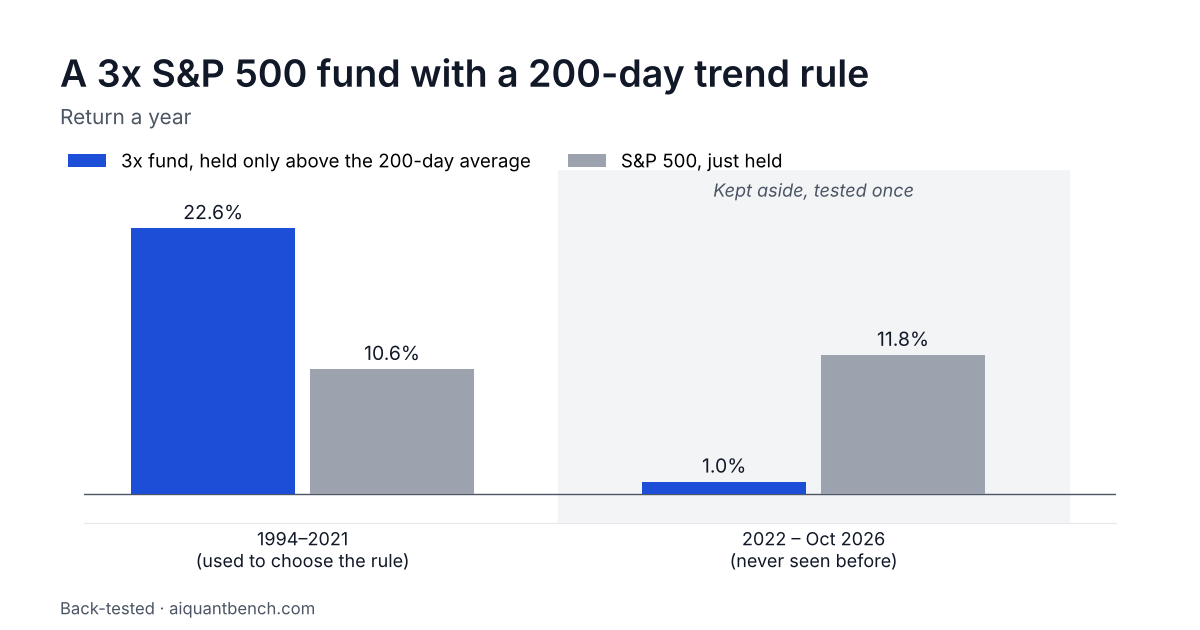
A 3x S&P 500 fund with a 200-day trend rule made 22.6% a year from 1994 to 2021. Since 2022, about 1% a year.
Didn't work · 19 Oct 2026 · 3 min read
Short answer: On 1994–2021 the rule more than doubled the S&P 500's yearly return. On 2022–2026, years it had never seen, it made about 1% a year against 12%, and fell 61% at its worst.
The dream: three times the market, without the crashes
Some funds move three times as much as the S&P 500 each day. Up 1% today means about 3% for the fund. Down 1% means about 3% down. UPRO is the best-known one.
Held through a crash, they're brutal. Held all the time from 1994, a 3x fund would at one point have lost 98% of your money.
So there's a popular fix: own the 3x fund only while the S&P 500 is above its 200-day average, and sit in cash otherwise. Crashes usually happen when the market is already falling, so you should be out of the way when it matters.
I tested it. On 28 years of history it more than doubled the market's yearly return. Then I ran it on the next five years, which I had kept aside the whole time, and it made almost nothing.
The result
| 1994–2021: a year | Worst drop | 2022 – Oct 2026: a year | Worst drop | |
|---|---|---|---|---|
| 3x fund, held only above the 200-day average | 22.6% | −57.5% | 1.0% | −61.4% |
| S&P 500, just held | 10.6% | −55.2% | 11.8% | −24.5% |
("A year" is the average yearly growth, compounded. "Worst drop" is the biggest fall from a peak to a later low.)
On the years it was chosen on, the rule looked like the dream come true. On the years it had never seen, 100,000 put in at the start of 2022 became about 104,800. The plain S&P 500 turned the same money into about 170,600, with a far gentler ride.
Why it failed
The great 1994–2021 result rested on just two bear markets: the dot-com crash and 2008. Both fell steadily for many months. The index dropped below its average, the rule moved to cash, and it sat out the worst.
The 2022 fall was different: slow and choppy. The index kept dipping below its average and climbing back above it. Every time it climbed back, the rule bought the 3x fund again, just before the next drop. A normal investor lost a little each time. The 3x fund lost three times as much, again and again.
How I tested it
Skip this if you trust me.
- The rule: hold the 3x fund while the S&P 500 is above its average price of the last 200 trading days. When it closes a month below, sell and hold US Treasury bills. Check on the last trading day of each month and act the next day.
- The fund: real 3x funds only exist since 2009, so for earlier years I rebuilt one from the S&P 500's daily moves, charging what such a fund really pays: borrowing at the Treasury bill rate plus 0.5% a year, and fees of 0.9%. The rebuilt fund closely matched the real 2x and 3x funds where they overlap.
- Choosing: I tried a few versions on 1994–2021 (2x or 3x, checked monthly or daily), picked the best and froze it.
- The exam: 2022 to October 2026 stayed sealed until the rule was frozen. Then I ran it once.
The catch
Two bear markets are very few to learn from, which is exactly why the first result fooled me. The sealed years are short too. A different rule might have handled 2022 better, but picking one now, knowing what 2022 looked like, would repeat the same mistake.
What I took from it
A trend rule can soften a long, steady crash. It doesn't reliably protect a leveraged fund, because leverage multiplies every false start. And a rule can look brilliant for 28 years and fail on the next five, which is why I always keep some years sealed.
If you hold a leveraged fund with a rule like this, how did it do for you in 2022? And where do you think this test could be wrong?